

If you’ve followed GrandCollector’s “Do You Need This in Your Collection?” series, you already know the short answer here: adding an 1884 Trade Dollar to your collection is exceptionally difficult.
That is exactly why the coin is worth studying. Its rarity is clear, but its production history is less settled.
Here is what the published record tells us, and where the evidence still leaves questions.
1884 Trade Dollar:
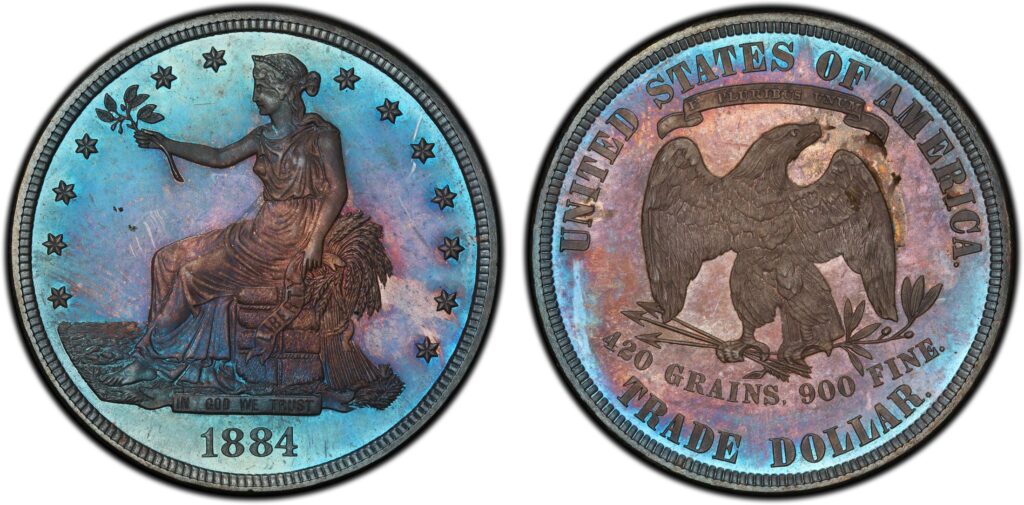
The rarity of the 1884 Trade Dollar
PCGS CoinFacts lists 10 struck for the 1884 Trade Dollar proof, while Numismatic News notes that some references have suggested 264. The two figures describe a question that remains unsettled, not a simple agreed mintage. The 1884 issue is one of the hobby’s major rare coins. Numismatic News also reports that Arlie Slabaugh found Treasury sheets supporting the higher figure.[1][2]
Numismatic News describes the pieces as a product of the Mint’s proof-era activity and records long-running questions about their legitimacy. Those questions have not erased their standing as major rarities in the collecting market.[2]
Collectors have debated the legitimacy of such pieces, but the 1884 Trade Dollar has been accepted by the hobby for years and remains a major rarity.[2] See also GrandCollector’s guide to the world’s most collectable coins.
The 264 figure is difficult to reconcile with the known survivors because proof coins from the period generally have higher survival rates, according to Numismatic News.[2]
Historical Context
The historical record does not settle the count. Numismatic News says the 264 figure came from a fiscal-year total and notes Treasury sheets attributed to researcher Arlie Slabaugh.[2]
The Trade dollar had not been officially terminated in 1884. Numismatic News explains that production had been limited to proof examples from 1879, with mintage determined by the number of requests received by the Mint. That is why it describes an 1884 issue as not technically illegal.[2]
The result is two competing figures, 10 and 264, without a clean way to reconcile them. The published account says the 264 figure may have covered a fiscal year rather than a single dated issue.[2]
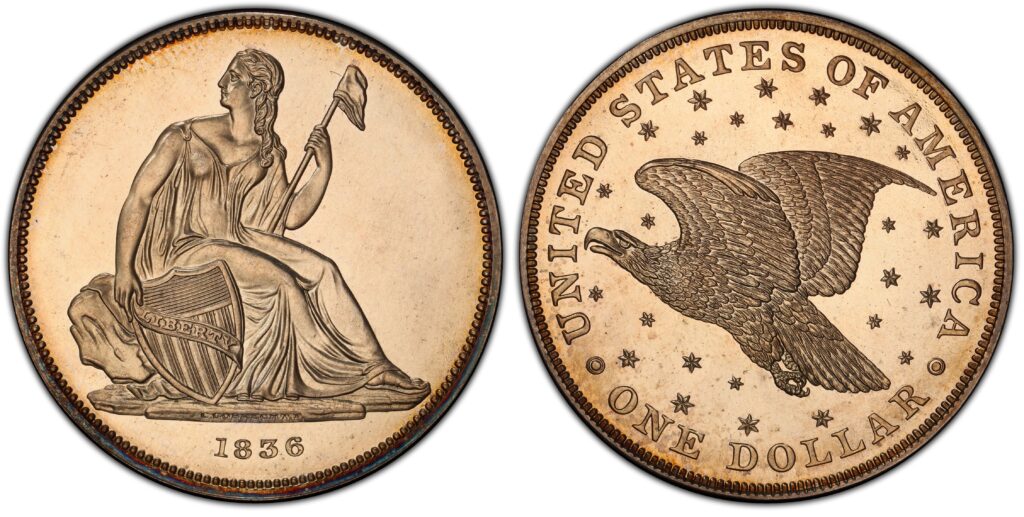
Numismatic News also raises the possibility that older dollars were recoined, including pieces dated 1836 or 1837. It presents that as a possible explanation, not a settled conclusion.[2]
The same account notes that 1836-dated dollars exist, while special Gobrecht dollar restrikes were made for many years. That history leaves open the possibility of a connection, but it does not prove how the 1884 Trade Dollars were produced.[2]
On the available evidence, the safest conclusion is that the 1884 Trade Dollar’s exact production story remains unresolved. Presenting either 10 or 264 as an uncontested final answer would overstate the record.[2]
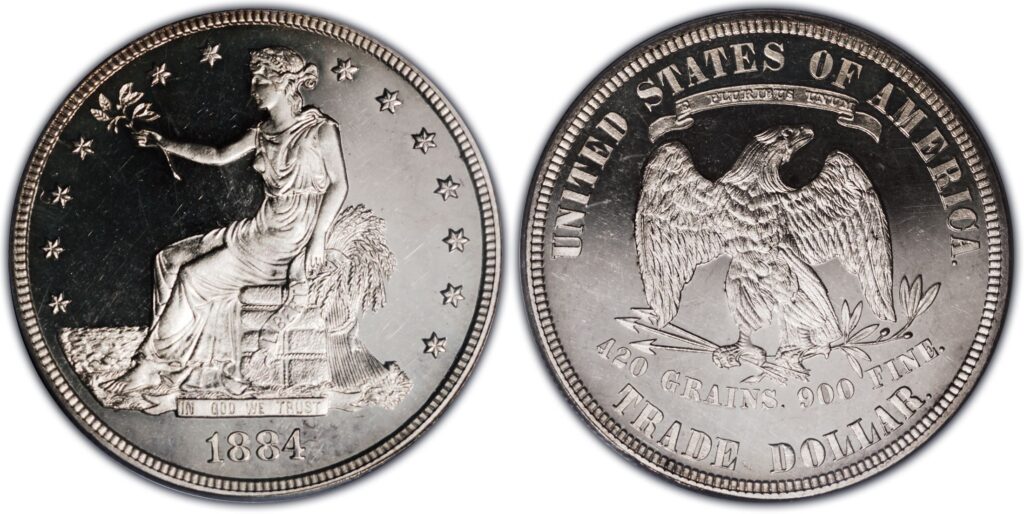
Unless additional records surface, the exact relationship between the 10-piece figure, the 264 fiscal-year figure, and the surviving coins may remain uncertain.[2]
The 1884 and 1885 Trade Dollars are major rarities. For a current price claim, collectors should use a dated auction result or a current price guide instead of relying on a broad estimate.[3]
Collectability and Value
The market has recorded seven-figure results for the 1884 proof. PCGS lists a $1,140,000 auction record for a 1884 Trade PR coin, realized at Heritage Auctions on January 14, 2019.[3]
A single auction record is not a valuation for every specimen. It belongs to one specific coin, grade, venue, and sale date, so compare the individual coin with recent, verifiable results.
Related Articles:
Notes
- [1] PCGS CoinFacts, 1884 T$1 Trade (Proof) Trade Dollar.
- [2] Numismatic News, Questions Persist Over 1884 Trade Dollars.
- [3] PCGS Auction Prices, Trade Dollar, 1884 Trade PR.
Fact-checked and refreshed September 24, 2026. This article is part of GrandCollector’s editorial freshness program, which periodically reviews older content to keep collector guidance accurate.