

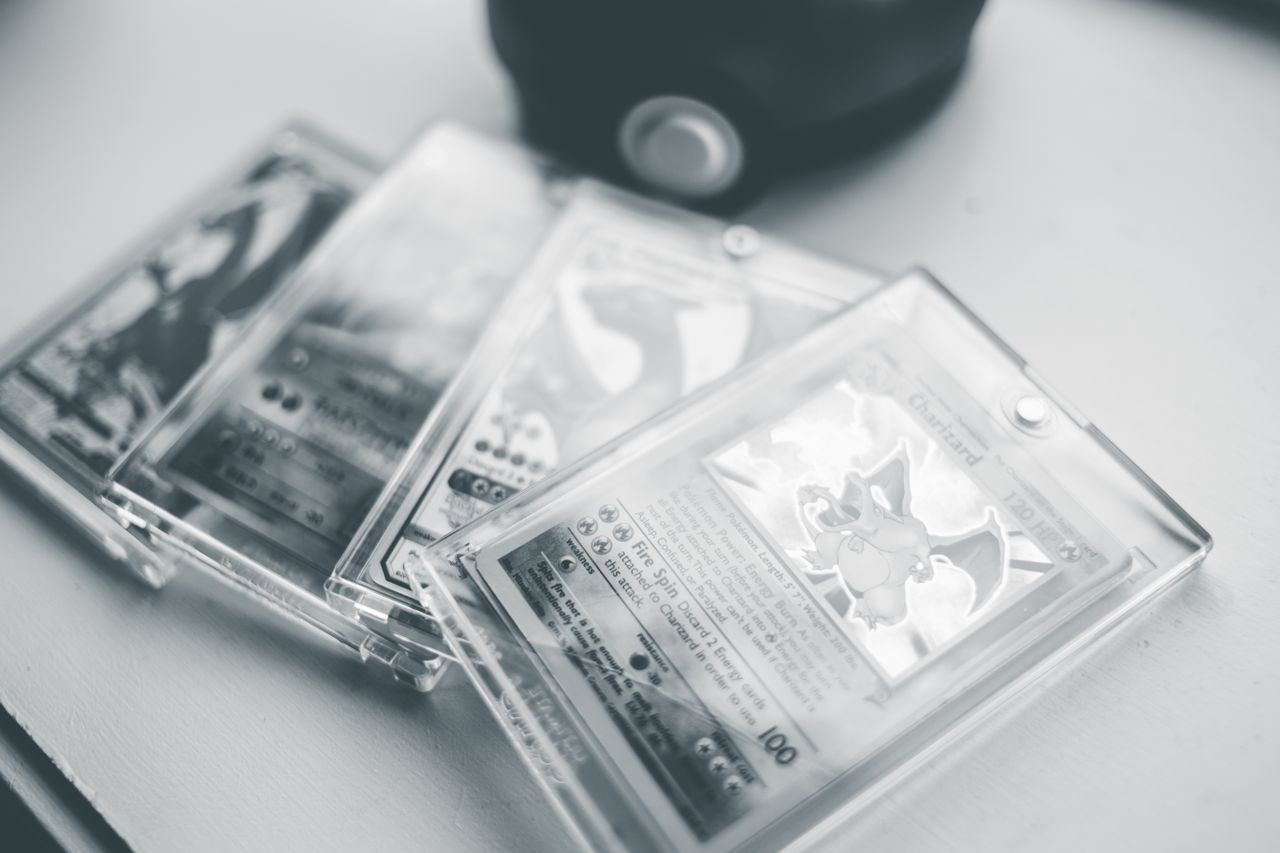
Print variants are not hidden. The clues sit in three places you already look at: the expansion symbol, the card number beside it, and the copyright line along the bottom. Each one records something different. The symbol and the number identify the set and the card. The copyright line gives you one clue to the print run. Separating a 1st Edition card from a later print of the same card is a separate test: the 1st Edition stamp, plus the shadowless traits that the 1st Edition and Shadowless Unlimited prints share.
Key takeaways
- Set symbol and card number name the set and the card; they do not separate 1st Edition, Shadowless, and Unlimited prints of that card.
- Shadowless and 1st Edition prints share a layout, so the stamp separates them.
- A later Unlimited print reads a different copyright line, so use that line as a flag.
What the set symbol and card number actually tell you
The expansion symbol identifies the set. The card number identifies the card within that set. Together they tell you which set a card belongs to and which card it is [3].
One kind of alternate printing keeps both marks and changes the number line instead. “Yellow A Alternate” cards keep the same card number and expansion symbol as the original print, and the only numbering change is the letter “a” added after the number [2]. The source lists those cards as legal in the same formats as the original prints [2].
How the 1st Edition stamp and shadowless traits work
1st Edition cards come from the first print run of a set. They are typically available only in booster packs for a limited period after release, then the set continues as Unlimited Edition until its printing ceases [1].
Shadowless cards have no drop shadow around the illustration window, and they use thinner HP values and attack text than later Unlimited prints [1]. The 1st Edition print shares both. That overlap is why the stamp matters. On an English Base Set card it is the easiest way to separate a 1st Edition card from a Shadowless Unlimited card [1].

Reading the copyright line
The bottom copyright line gives you a second, independent test, and it also works where the illustration window test does not.
Trainer and Energy cards have no illustration window at all, so a drop shadow cannot separate their printings. On those, compare thinner text and the copyright line instead [1].
The Shadowless line reads “© 1995, 96, 98, 99 Nintendo”. Unlimited cards drop the 99 and read “© 1995, 96, 98 Nintendo” [1]. A later Unlimited printing reads “©1999–2000” instead, so the copyright line alone will not sort every card into Shadowless or Unlimited [1]. Treat it as one clue among several.
Where this breaks down
One limit catches collectors who read English guides and then buy Japanese or other non-English cards. The Shadowless print was exclusive to the English Base Set. In other languages, 1st Edition cards used the same layout as their Unlimited prints [1]. Run the shadowless test on a non-English card and you will get a wrong answer.
Check the card number and, where your set prints one, the expansion symbol to confirm which card you are holding. On a Yellow A Alternate card, look for the letter “a” added to the card number. Where an early English set gives you a readable copyright line, use it to flag a different print run. Those details tell you which card you have and give you a first print-run clue; the 1st Edition stamp and shadowless traits settle it. If you buy in bulk, run the same bottom-edge check as you inspect Pokémon card lots before a card show.

Notes
[1] Bulbapedia, “1st Edition (TCG)”: https://bulbapedia.bulbagarden.net/wiki/1st_Edition_(TCG)
[2] Bulbapedia, “Standard format (TCG)”: https://bulbapedia.bulbagarden.net/wiki/Standard_format_(TCG)
[3] Bulbapedia, “Pokémon (TCG)”: https://bulbapedia.bulbagarden.net/wiki/Pok%C3%A9mon_(TCG)