
Disclosure: This article may contain affiliate links. If you buy through them, GrandCollector may earn a commission at no extra cost to you.
Fact checked: September 27, 2026.
If you’re a coin collector or a history enthusiast, the value of a 1795 Flowing Hair Half Dollar depends on its variety, grade, certification, and auction history.
The Flowing Hair Half Dollar belongs to the first U.S. half-dollar issue, which began in 1794.
The 1795 date is part of a short 1794-1795 design type, and examples are collected by date, variety, grade, and attribution.
Here is what the available specifications, variety information, price guides, and recorded auction results can tell you about the coin’s market value.
The 1795 Flowing Hair Half Dollar
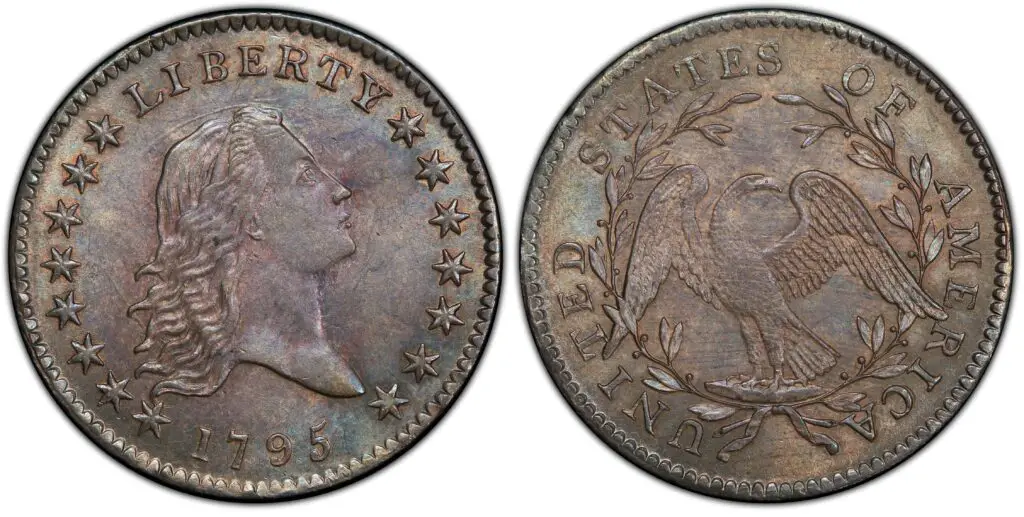
The 1795 Flowing Hair Half Dollar is an early U.S. silver half dollar designed by Robert Scot. The U.S. Mint identifies 1794 as the first year of the denomination, so a 1795 example is part of the second year of this initial design type.
The Flowing Hair half dollar was produced from 1794 to 1795. The Smithsonian’s record for the 1794 issue describes it as the first half-dollar minted for circulation by the United States.
Robert Scot is identified as the designer. The obverse shows Liberty with flowing hair, while the reverse has a small eagle inside a wreath. The design was later followed by the Draped Bust type.
The obverse carries LIBERTY and the date, with 15 stars around Liberty. The reverse carries UNITED STATES OF AMERICA around the eagle and wreath.
PCGS lists the coin at 32.5 mm in diameter and 13.48 grams in weight, with a composition of 90% silver and 10% copper.
The coin has a lettered edge with the inscription “FIFTY CENTS OR HALF A DOLLAR.”
PCGS lists a mintage of 299,680 for the 1795 Flowing Hair Half Dollar.
Mintage is only a starting point. A surviving coin’s variety, preservation, certification, and eye appeal can produce very different prices.
Collectors pursue the date across several recognized varieties, including the regular issue and recut-date and three-leaves varieties.
That variety structure is one reason a date-and-mintage figure cannot serve as a valuation by itself.
Factors Influencing the Value
Several factors matter when estimating the value of a 1795 Flowing Hair Half Dollar.
Start with the variety and grade, then compare certified examples and recent sold results for the same or a closely comparable variety.
- Rarity
- The mintage is 299,680, according to PCGS. That number covers the 1795 issue and does not tell you how many examples survive or how many belong to a specific variety.
- PCGS catalogs several 1795 varieties. The 1795/1795 recut-date, three-leaves variety is a distinct variety, and Heritage describes the O-111 pairing as highly desired by variety and type collectors.
- Condition
- Condition is a major pricing factor. Compare coins with similar wear, surface quality, strike, and certification.
- A higher grade does not erase problems such as cleaning or damage, so the certified grade and the coin’s actual surfaces both deserve attention.
- PCGS and NGC certification gives buyers a standardized point of comparison, but NGC cautions that guide prices are averages and can vary with market conditions and the individual coin.
- Historical Significance
- The date belongs to the first U.S. half-dollar design type, which gives the issue historical context.
- The Smithsonian identifies Robert Scot as the designer of its 1795 example.
- Those historical details explain the coin’s place in early U.S. coinage, but they do not set a fixed market price.
In practice, variety, condition, certification, provenance, and comparable sales are more useful to a buyer than a broad claim that every 1795 half dollar has the same value.
Use them to build a realistic comparison, then inspect the specific coin before deciding what it is worth to you.
Condition and Grade
Condition and grade help buyers compare one 1795 Flowing Hair Half Dollar with another, but the label does not replace an inspection of the actual surfaces.
PCGS and NGC use the familiar circulated and Mint State grading designations. The grade reflects preservation, while details such as cleaning, damage, strike, and eye appeal can still affect how the coin is viewed and priced.
For an early half dollar, compare wear, surface preservation, strike, and any qualifiers shown on the certification.
A numerical grade is useful only when the coin is compared with similar certified examples.
These are the broad grade ranges a buyer is likely to encounter:
- Poor through Good (P-G): Heavy wear, with the main design elements becoming progressively clearer as the grade rises.
- Very Good through Extremely Fine (VG-XF): Circulated grades with increasing detail and less wear.
- About Uncirculated (AU): A lightly circulated coin with only limited wear.
- Mint State (MS): An uncirculated grade range in which small differences in preservation, strike, and surfaces can materially affect comparisons.
Published guides are reference points, not guaranteed selling prices. NGC’s price-guide page says its figures are averages and that the actual value of an individual coin can vary. Recorded auction results show how wide the range can be:
| Recorded example | Sold price |
|---|---|
| PCGS MS65, May 19, 2015 | $411,250 |
| PCGS MS64, January 15, 2023 | $348,000 |
These are individual auction results, not a price promise for every coin with the same date. Heritage and NGC identify the grade and variety for each lot, so comparisons should be made at that same level of detail.
A coin with a different variety, grade, problem designation, or provenance may sell for a very different amount.
Rarity and Demand
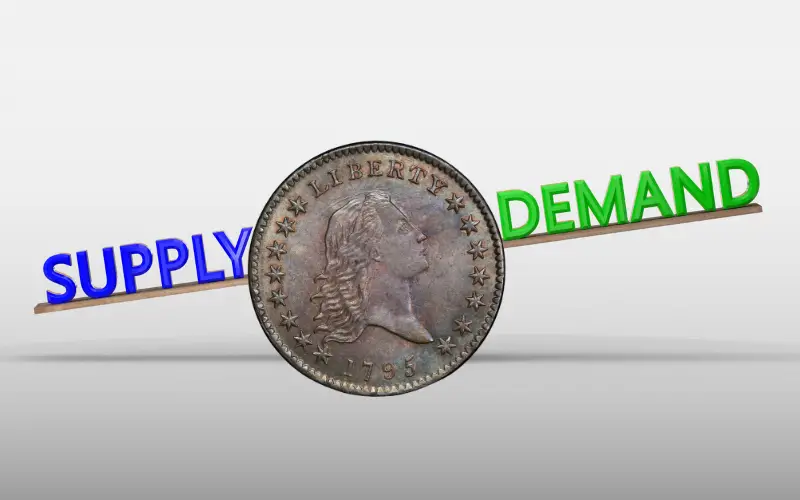
The 1795 Flowing Hair Half Dollar is a scarce early issue with multiple recognized varieties.
The design was minted in 1794 and 1795. A reliable surviving-population estimate for the 1795 date is not established in the sources used here, so the mintage figure should not be presented as a surviving census.
Demand is especially visible in the market for well-preserved and distinctly attributed examples.
The auction record is therefore more useful when paired with the exact grade and variety than when treated as a typical price for the date.
For circulated coins, use a current price guide and recent comparable sales for the same grade and variety. Avoid treating a single online estimate as a firm offer.
Uncirculated examples can command much more than circulated pieces, but the two auction records above show why grade and variety must be stated alongside any price.
Two recorded auction results:
- NGC lists a PCGS MS64 example sold for $348,000 on January 15, 2023.
- NGC lists a PCGS MS65 example sold for $411,250 on May 19, 2015.
- These results are historical records for the listed lots. They are not a current appraisal for an uncertified or differently graded coin.
Demand reflects several factors, including the early date, the design, the recognized varieties, and the condition of the individual coin.
The obverse’s flowing-hair Liberty and the reverse’s small eagle and wreath give the type a distinct appearance.
It is also part of the first U.S. half-dollar issue, which began in 1794.
Price follows the specific coin. A desirable date does not make every example a high-grade or record-setting piece.
That is why a buyer should compare the exact variety and grade before deciding whether an asking price is reasonable.
Collectors may value the coin for its place in early U.S. coinage, but a purchase should be judged on the individual coin and the evidence supporting its price.
Market Trends
A single result cannot establish a trend for the whole 1795 issue. Market comparisons are most useful when the variety, grade, certification, and sale date are all visible.
Prices can change with the coin’s condition, attribution, provenance, and the circumstances of a sale.
Condition remains one of the most important factors in a comparison.
Compare the actual surfaces and any problem or details designation, not just the headline grade.
Variety is another factor. PCGS lists multiple 1795 varieties, and some variety-and-grade combinations have their own auction histories.
If you are considering a purchase, research the variety and compare recent sales for coins with similar certification and preservation.
The coin’s historical importance can make it appealing, but it does not replace evidence about the particular piece being offered.
The value of a 1795 Flowing Hair Half Dollar can vary widely with condition, variety, certification, provenance, and market timing.
The documented results in this article range from a circulated market that requires coin-specific comparison to six-figure Mint State auction records. That spread is why a single date-level price range would be misleading.
Before buying, verify the variety, review the certification, study the images, and compare the price with recent sales of genuinely similar coins.
Provenance and certification can help you assess what is being offered, but neither one guarantees a particular resale price.
Notes
- [1] PCGS CoinFacts, 1795 50C Flowing Hair Half Dollar, for mintage, specifications, varieties, and the January 15, 2023 auction record.
- [2] Smithsonian National Museum of American History, 50 Cents, United States, 1795, for the design, edge lettering, and Robert Scot attribution.
- [3] Smithsonian National Museum of American History, 50 Cents, United States, 1794, for the first-half-dollar issue context.
- [4] Heritage Auctions, 1795/1795 50C 3 Leaves, O-111, for the variety description and collector demand context.
- [5] NGC U.S. Coin Price Guide and Auction Central, for the guide-price caveat and recorded auction comparisons.
Before you go…
The 1795 Flowing Hair Half Dollar has a documented place in early U.S. coinage and a market that rewards careful variety and grade comparisons.
If you are considering one, treat the recorded prices as context and judge the individual coin on its evidence, condition, and price.
Check out my next article: “Is the 1914-D Wheat Penny Worth Collecting?“
Related Articles: