

The 1841 Liberty Seated Half Dime belongs to the Liberty Seated half dime series, which ran from 1837 through 1873.
The design is credited to Robert Ball Hughes and Christian Gobrecht. The obverse shows Liberty seated on a rock, while the reverse carries an open wreath tied with a ribbon around the words HALF DIME. The eagle belongs to earlier half dime reverse designs, not this one.
Half dimes are an early United States five-cent denomination, but the denomination itself dates to 1794. That distinction matters when placing an 1841 coin in the country’s coinage history.
Key Takeaways:
1. The 1841 issue and the 1841-O issue are separate mint varieties.
2. Confirm the date, mintmark, condition, and attribution before comparing examples.
3. The reverse uses a wreath around HALF DIME, not an eagle.
Do You Need This Coin In Your Collection?
That depends on your collecting goals. The 1841 Philadelphia issue and the 1841-O New Orleans issue are separate coins, so the mint, condition, attribution, and documentation all need to be considered together.
Age alone does not establish a coin’s place in a collection. Compare the coin with the correct mint issue and grade before deciding whether it fits your collection.
A careful purchase starts with confirming the date, mintmark, surfaces, and documentation rather than relying on the date alone.
The 1841 Liberty Seated Half Dime
The Era of the Half Dime
The half dime was a silver five-cent denomination. The U.S. Mint says the smaller silver half dime continued alongside the nickel until 1873.
By 1841, it was part of the established Liberty Seated series. Its small size makes the date and design details worth checking closely on any example.
The 1841 issues are documented as 90% silver and 10% copper [2][4]. That composition is useful identification context, but it does not by itself establish collectibility.
The Liberty Seated Design
The Liberty Seated design began on half dimes in 1837 and continued through 1873.
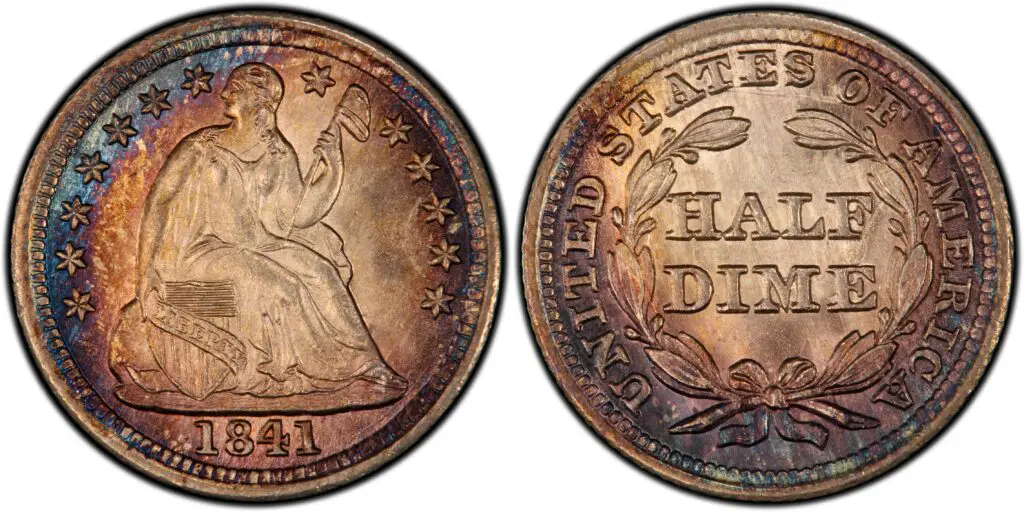
On the obverse, Liberty sits on a rock with a liberty cap and shield. The reverse has an open wreath tied with a ribbon, enclosing HALF DIME.
For half dimes, the Liberty Seated series ended in 1873. The 1841 issue is a Type 3 variety with stars on the obverse.
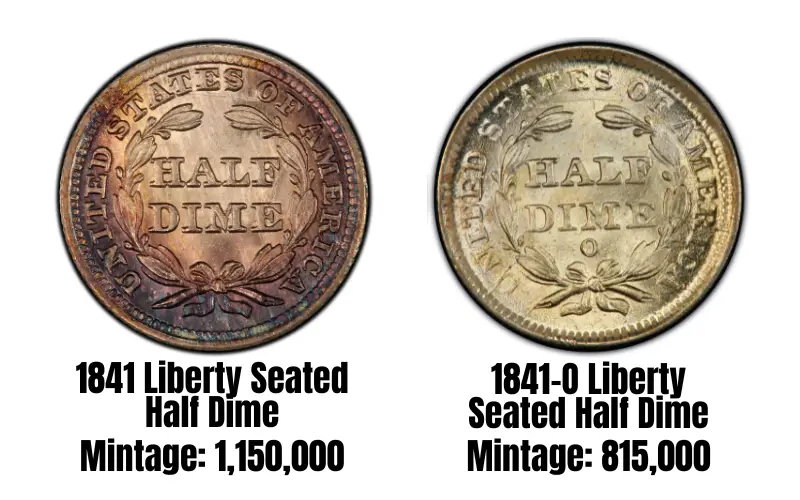
In 1841, the Liberty Seated Half Dime was struck at Philadelphia and New Orleans. The Philadelphia issue has no mintmark; the New Orleans issue is identified by an O.
Keep the Philadelphia and 1841-O issues separate when checking catalogues, issue records, or other documentation.
The New Orleans issue is a separate variety from the Philadelphia coin, and it should not be confused with the Liberty Seated dimes struck in the same period.
The Minting Process
Calling 1841 coinage simply “by hand” is too broad. The U.S. Mint describes early hand-struck coinage on screw presses, while its history records a steam coin press at Philadelphia from 1836.
Available sources do not identify the press used for each individual 1841 striking, so the press should not be used as a shortcut for evaluating a coin.
Reference specifications give the type as 15.90 millimeters in diameter, 1.34 grams, with a reeded edge and a 90% silver, 10% copper composition [2].
Those specifications are reference points, not a substitute for a complete review. Wear, damage, alteration, and measuring error can all affect an examination.
For a purchase, compare the coin with reliable photographs or a reputable certification record and check the date and mintmark before assessing condition.
Comparing 1841 Liberty Seated Half Dimes
Use no single comparison for every 1841 Liberty Seated Half Dime. Any assessment needs to match the mint, condition, documentation, and the individual coin.
Factors Influencing Value
Use these factors when comparing examples:
- Condition
- Condition and preservation affect how collectors compare examples.
- Damage, cleaning, and heavy wear can change the comparison, even when the date is the same.
- Documentation
- Documented mint information is a starting point, not proof of how many examples survive.
- Keep the Philadelphia and 1841-O issues separate when comparing records.
- Mint Mark
- The mintmark identifies the issue being compared.
- Compare a Philadelphia coin with Philadelphia records and an O-mint coin with 1841-O records.
- Historical Significance
- Historical context helps identify the coin, but it does not guarantee a premium.
- Authenticity and the coin’s actual condition should come before any claim about a premium.
Checking Current Evidence
Market references change over time. Compare the specific coin with current records before deciding whether to buy or sell.
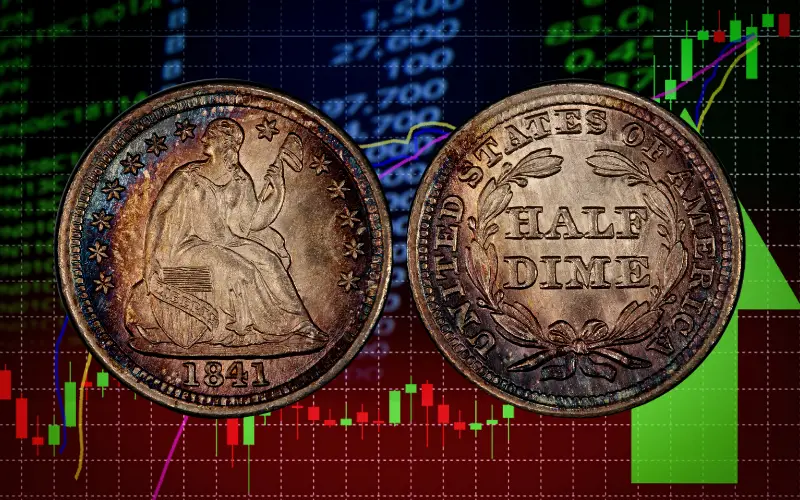
The earlier USA Coin Book reference and the image retained below should not be treated as a current comparison source.
For a useful comparison, match the date, mintmark, grade, certification, and coin-specific defects before relying on a reported result.
The image and figures retained from the original article are historical material, not current guidance.
An uncirculated label does not establish one fixed conclusion. Verify the grade, certification, and current evidence for the specific coin.
Demand, timing, venue, and the coin itself can all affect a result, so avoid treating an old estimate as a guarantee.
In practice, start with attribution and condition, then compare the correct mint issue with recent market evidence.
That approach is more useful than applying one conclusion to every 1841 half dime.
Notes
- U.S. Mint, Nickel history – accessed September 27, 2026.
- PCGS CoinFacts, 1841 H10C – accessed September 27, 2026.
- PCGS CoinFacts, Liberty Seated Half Dime category – accessed September 27, 2026.
- PCGS CoinFacts, 1841-O H10C – accessed September 27, 2026.
Before you go…
The 1841 Liberty Seated Half Dime can be a good fit for a collection built around early U.S. denominations or the Liberty Seated series. Make the decision from the coin in front of you, not from the date alone.
Check out my next article: “1866 5c Shield Nickel Guide“
Related Articles: