

A No-Nonsense Guide to Building a Real Collection Without Breaking the Bank
Let me be honest with you upfront: most stamp articles you’ll find online are practically useless for anyone who actually wants to collect stamps.
This guide is different. Every stamp here is something you can realistically find and afford in 2026. We’re talking $10 to $500 for most of these, with even the pricier options staying well under $1,000. These aren’t consolation prizes either. These are genuinely interesting pieces of postal history that serious collectors actually want in their albums.
I’ve fact-checked every price and historical detail here, because nothing’s more frustrating than reading about a “$50 stamp” only to discover it actually costs $500. So let’s get into it.
1. The 1840 Penny Black (Great Britain)
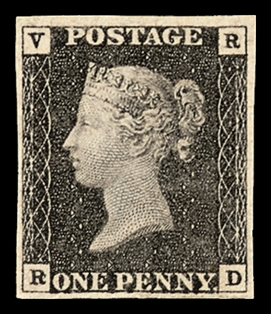
Here’s something that surprises most people: you can own the world’s first postage stamp for a couple of hundred bucks.
The Penny Black revolutionized communication when it appeared on May 6, 1840. Before it existed, sending a letter was a complicated, pay-as-you-go system where the recipient paid based on distance and weight.
Sir Rowland Hill’s radical idea was simple: pay one penny upfront, stick a stamp on your letter, and done. It sounds obvious now, but at the time it was revolutionary.
So why isn’t the world’s first stamp worth millions? Because the British printed 68.8 million of them. That’s not a typo. In less than a year, 286,700 sheets rolled off the presses.
About 1.3 million are estimated to survive today, roughly 2% of the original run. That’s actually a higher survival rate than most stamps because Victorians didn’t use envelopes much.
They’d fold their letters with the stamp on the outside, and when lawyers and banks filed those letters away, the stamps came with them.
| Quick Facts | |
| Year Issued | 1840 |
| Country | Great Britain |
| Design | Queen Victoria profile (age 15, from William Wyon cameo) |
| Printed | 68,808,000 stamps from 12 plates |
| What to Look For | Maltese cross cancellation, corner letters AA-TL, plate number |
| 2026 Price Range | Used with decent margins: $100-400 |
Look for four clear margins and a not-too-heavy cancellation. Plate 11 stamps (only 168,000 printed) command premiums if you want to spend more.
2. The 1840 Two Penny Blue (Great Britain)
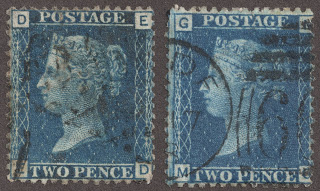
If you want something rarer than the Penny Black for similar money, the Two Penny Blue is your ticket.
Issued just two days after the Penny Black, the Two-Penny Blue was used for heavier letters up to 1 oz.
But here’s the thing: most collectors don’t realize that only 6.46 million were printed, compared to 68 million Penny Blacks. That makes it roughly ten times scarcer.
The 2d Blue gets overlooked because it wasn’t “the first.” But rarity-wise, it probably should be priced higher than it is. You can still find used examples of the later white-line versions for $15-30.
Original 1840 first-issue examples without the white lines run $100-325, which is frankly undervalued for a stamp ten times rarer than its famous sibling.
| Quick Facts | |
| Year Issued | 1840 (first issue), 1841 (white lines added) |
| Country | Great Britain |
| Design | Same Queen Victoria profile as Penny Black |
| Printed | 6,460,000 from two plates (original 1840 issue) |
| Key Distinction | No white line = 1840 original; white lines = 1841+ issue |
| 2026 Price Range | 1840 original: $100-325; 1841+ versions: $15-80 |
Pro tip: Check for the white horizontal lines below “POSTAGE” and above “TWO PENCE.” If they’re absent, you’ve got an 1840 original. If they’re present, it’s the more common 1841 revision.
3. The 1893 Columbian Exposition Series (USA)
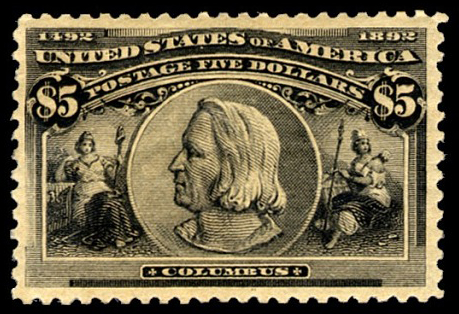
America’s first commemorative stamps are still surprisingly affordable more than 130 years later.
The Columbian Issue of 1893 celebrated the 400th anniversary of Columbus’s voyage (a year late, but who’s counting). The Post Office pulled out all the stops: 16 denominations, elaborate designs inspired by historical paintings, and a size nearly twice that of regular stamps.
At the time, collectors were furious. The full set cost $16.34, roughly $450 in today’s money, which was a week’s wages for many workers. Stamp clubs formed specifically to protest what they called speculative excess. A group literally called themselves the “Society for the Suppression of Speculative Stamps.”
But here’s the good news for us: the low values sold by the hundreds of millions. Over 2 billion Colombian stamps were printed.
You can build a nice low-value set (1c through 8c) for under $50-150, depending on condition.
| Quick Facts | |
| Year Issued | January 2, 1893 |
| Country | United States |
| Significance | First U.S. commemorative stamps |
| Set Composition | 16 values from 1 cent to $5 |
| Best Values for New Collectors | 1c, 2c, 3c, 4c, 5c, 6c, 8c, 10c |
| 2026 Price Range | Individual low values: $5-50; 1c-8c set: $50-150 |
4. The 1898 Trans-Mississippi Series (USA)
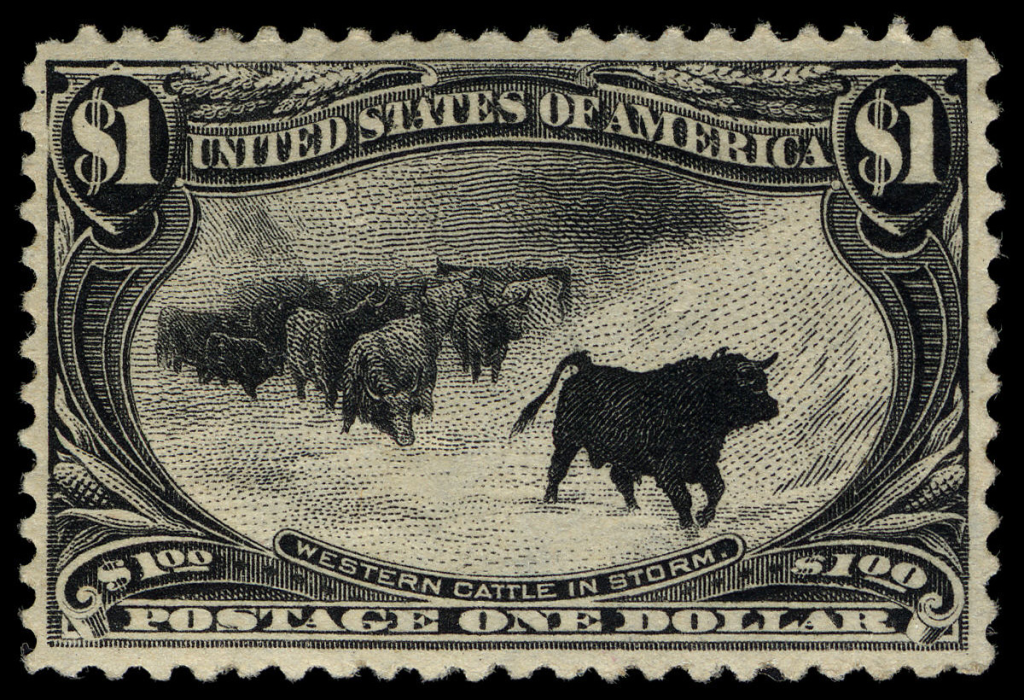
Many collectors consider these the most beautiful stamps America ever produced. And the low values won’t clean out your wallet.
The Trans-Mississippi stamps were issued for the 1898 Omaha Exposition, celebrating the American West. Unlike the Columbians, these stamps feature evocative scenes of frontier life: Father Marquette on the Mississippi, farming the Western plains, covered wagons heading into the sunset.
The $1 “Cattle in Storm” is frequently called the finest U.S. stamp ever engraved. The intricate detail shows a herd of cattle led by a majestic bull seeking shelter from a blizzard. (Fun fact: the cattle in the original painting were actually Scottish Highland cows, not American.) That stamp alone is worth $1,400+ in hinged condition, so it’s not exactly achievable for everyone.
But the low values are very accessible. The 1-cent through 10-cent values feature beautiful Western scenes and can be acquired for $20-$250, depending on the denomination and condition.
Sales of these stamps disappointed the Post Office at the time, so unsold stock was recalled and destroyed, making surviving examples genuinely scarce.
| Quick Facts | |
| Year Issued | June 17, 1898 |
| Country | United States |
| Set Composition | 9 values from 1 cent to $2 |
| Reputation | Widely regarded as most beautiful U.S. stamps |
| Best Values for Collectors | 1c Marquette, 2c Farming, 4c Indian Hunting, 5c Fremont, 8c Cavalry, 10c Hardships |
| 2026 Price Range | 1c-10c values: $20-250 depending on condition |
Why these matter: The detail in the engraving is simply extraordinary. Hold one under magnification, and you’ll see why collectors have treasured these for over 125 years.
5. The Washington-Franklin Series (USA, 1908-1922)
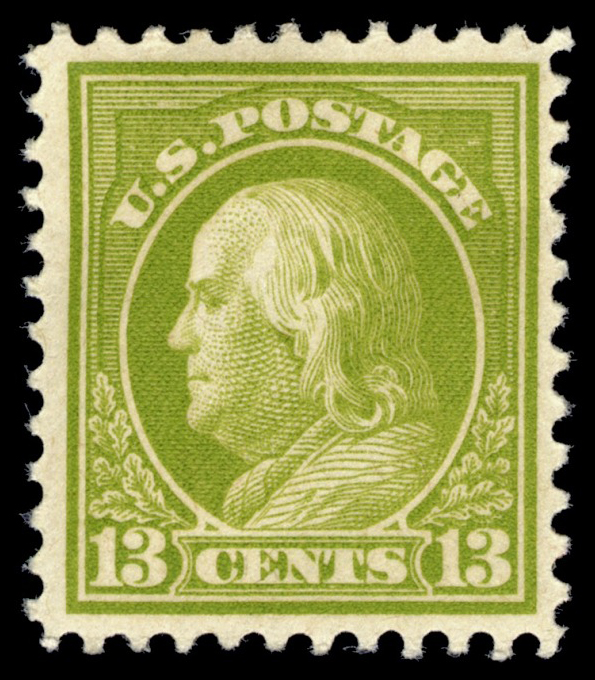
If you love puzzles and don’t mind spending years figuring out what you actually have, this series is for you.
On the surface, these are dead simple: just two portraits (Washington and Franklin) with identical frames. The Post Office figured simpler designs would mean easier production. What actually happened was 14 years of experimentation with different papers, perforations, watermarks, printing methods, and colors that created a collector’s nightmare, or paradise, depending on your perspective.
There are over 200 varieties in this series. Some experts count over 300 when minor variations are included. The same basic 2-cent Washington stamp exists in dozens of collectible forms, depending on whether it was flat-plate or rotary printed, which watermark it has, how it’s perforated, and which paper type was used.
The good news: common varieties start at just a few dollars. The challenge is figuring out exactly which variety you have. It’s like stamp collecting and detective work combined.
| Quick Facts | |
| Years Issued | 1908-1922 |
| Country | United States |
| Design | George Washington or Benjamin Franklin profiles |
| Known Varieties | 200+ major, 300+ including minor variations |
| Variables | Perforation gauge, watermark, paper type, printing method, color shade |
| 2026 Price Range | Common varieties: $1-20; scarce varieties: $50-500+ |
Where to start: Get the Scott U.S. Specialized catalog and a perforation gauge. The 2-cent carmine Washington is the most common starting point. Just identifying which of the nine different types you have is an education in itself.
6. The 1868 F Grill Stamps (USA)
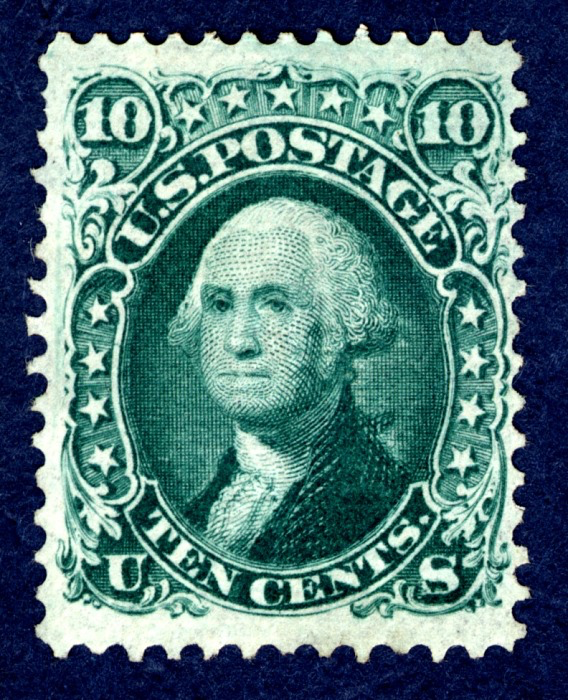
You’ve probably heard of the Z Grill, the American stamp that sold for $4.4 million in June 2024. Here’s how to own a piece of that same technology for pocket change.
In 1867-68, the Post Office had a problem: people were washing cancellation ink off stamps and reusing them. Charles Steel of the National Bank Note Company invented a solution: a grilling machine that pressed a waffle pattern into the stamp paper, allowing cancellation ink to soak deeply into the fibers, where it couldn’t be removed.
The government experimented with different grill sizes, labeled A through J and Z. The Z Grill was used for only about 1,000 stamps of certain denominations before they switched to the F Grill, which became the standard.
The result: Z Grills are impossibly rare (only 2 of the 1-cent are known to exist), while F Grills were produced in the hundreds of millions.
A used 3-cent Washington F Grill can be found for as little as $10. Even the 1-cent Franklin F Grill runs around $200-400 for decent examples. You’re holding the same anti-fraud technology that makes the Z Grill worth millions, just from a slightly larger production run.
| Quick Facts | |
| Years Used | 1867-1871 |
| Country | United States |
| Technology | Embossed waffle pattern to prevent cancellation removal |
| F Grill Size | 11-12 x 15-17 points |
| Production | ~291 million F Grill stamps vs. ~1,000 Z Grill stamps |
| 2026 Price Range | 3c Washington F Grill used: $10-30; 1c Franklin F Grill: $200-400 |
Collector tip: Look at the back of the stamp. The grill creates tiny raised points you can feel with your fingernail. Rubbing a graphite pencil lightly on the back makes the pattern more visible. Watch out for fake grills; they do exist.
7. The 1872 Japan Dragon Stamps
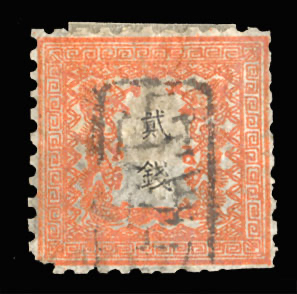
Japan’s first stamps feature dragons facing each other in a design borrowed from government currency. They’re genuinely gorgeous and genuinely available.
When Japan modernized its postal system in 1871-72, it chose the dragon, a symbol of imperial power and heavenly authority, for their first stamps. The design shows two dragons framing the denomination, printed on thick native paper without perforations or gum. Collectors have to cut them apart, just like the Penny Black.
These “Dragon mon” stamps (mon was the currency) were replaced in 1872 by “Dragon sen” stamps when Japan changed its currency system. The design remained similar, but the denomination changed. Then came the Cherry Blossom series in 1872-73, featuring Japan’s iconic flower.
Common Dragon sen and Cherry Blossom stamps are very affordable, ranging from $20 to $ 200 for genuine examples in decent condition. The earlier Dragon mon stamps and rare syllabic varieties can run into thousands, but those aren’t what we’re focusing on here.
| Quick Facts | |
| Years Issued | 1871 (mon), 1872 (sen), 1872-75 (Cherry Blossom) |
| Country | Japan |
| Design | Two dragons facing each other with denomination |
| Paper | Thick Japanese native paper (early issues) |
| Warning | Forgeries are common; buy from specialists or get authentication |
| 2026 Price Range | Common Dragon sen: $20-100; Cherry Blossom: $15-80 |
Important warning: Japanese classics are heavily forged. The Wada and Spiro forgeries are particularly common. Buy from dealers who specialize in Japanese stamps, or have your items authenticated by the International Society for Japanese Philately. A $50 “bargain” that turns out to be fake is no bargain at all.
8. The 1849-1850 France Ceres Issue
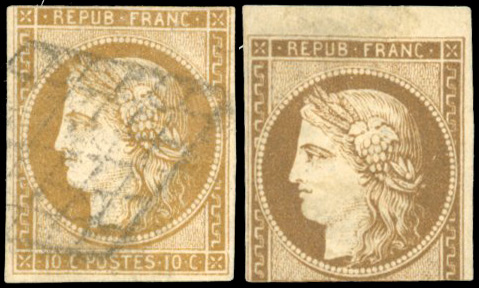
France’s first stamps are classical and elegant, featuring the goddess of harvest. And they’re surprisingly affordable.
France was the second country, after Great Britain, to introduce adhesive postage stamps. The design choice was politically neutral: rather than featuring a living monarch (France had just become a republic again in 1848), they chose Ceres, the Roman goddess of agriculture and fertility.
The Ceres design appeared on multiple French stamp issues from 1849 through 1876, giving collectors plenty of affordable entry points. The earliest 1849-50 issues are imperforated and printed in rich, deep colors. Later issues from the 1870s are perforated and less expensive.
These stamps combine historical significance (France’s first postage stamps) with genuine beauty (the classical goddess design is timeless) at very accessible prices.
| Quick Facts | |
| Years Issued | 1849-1850 (first issue), reprised through 1876 |
| Country | France |
| Design | Ceres, Roman goddess of harvest |
| Historical Context | France’s first stamps, issued under Second Republic |
| Denominations | 10c, 15c, 20c, 25c, 40c, 1 franc |
| 2026 Price Range | Common used: $15-80; 1870s Ceres: $5-30 |
9. New 2026 USPS Commemorative Issues

You don’t need a time machine or deep pockets to start collecting. The stamps being issued right now are the classics of tomorrow.
The USPS continues to release thoughtfully designed commemorative stamps that cost exactly face value: 78 cents as of July 2025 (with no increase planned for January 2026). Recent releases have honored Bruce Lee, Muhammad Ali, the Crab Nebula, and the Lunar New Year, among many others.
Will these stamps be worth money someday? Probably not much more than face value for most issues. The USPS prints millions, and unlike vintage stamps, almost all modern stamps get saved by collectors rather than used on mail.
But that’s not really the point. Collecting new issues teaches you about stamp design, printing techniques, perforation, and the hobby’s vocabulary without any financial risk. It’s also just fun to get new stamps in the mail. And who knows? The occasional modern issue can become valuable due to limited print runs, errors, or unexpected popularity.
| Quick Facts | |
| Current Price | 78 cents per Forever stamp (as of July 2025) |
| Recent Notable Issues | Bruce Lee, Muhammad Ali, Lunar New Year Horse, Crab Nebula |
| How to Collect | USPS.com, Mystic Stamp Company, local post offices |
| Why Collect | Zero financial risk, learn hobby basics, support postal service |
| 2026 Price | Face value (78 cents) for mint stamps |
Pro tip: First Day Covers (stamps on envelopes postmarked on their issue date) add interest without adding much cost. The USPS offers a subscription service that automatically sends you new issues as they’re released.
10. The 1864-1879 Penny Red Plate Numbers (Great Britain)
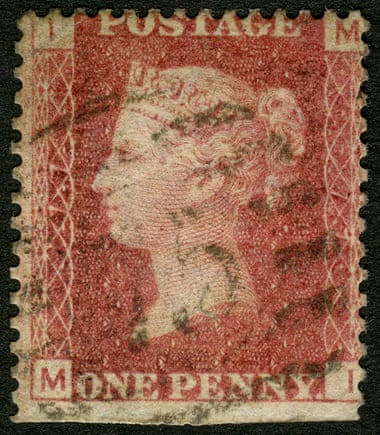
Building a complete set of 150+ plate numbers is the ultimate affordable long-term collecting challenge.
After the Penny Black’s red cancellation proved too easy to wash off, Britain switched to the Penny Red with black cancellation in 1841. The design evolved over the decades, and starting in 1864, the plate number was printed right on the stamp in tiny numerals within the side lacework.
Plates ran from 71 to 225, though not all numbers were used (plate 126 and 128 don’t exist, for example). About 21 billion Penny Reds were printed over nearly four decades, making most plate numbers very affordable. You can pick up common plates for $1- $ 5 each.
The challenge is completeness. Some plates are quite scarce. Plate 225, the last one used, routinely sells for three figures even in used condition. And then there’s Plate 77, which was rejected after printing just one sheet. Only a handful of examples exist, and one sold for $700,000+ in 2016.
You’ll never complete the set (nobody will, realistically), but that’s part of the fun. Each new plate number is a little victory.
| Quick Facts | |
| Years Issued | 1864-1879 (plates 71-225) |
| Country | Great Britain |
| Total Printed | Approximately 21 billion stamps over all Penny Red varieties |
| Plate Range | 71 to 225 (some numbers skipped) |
| Rarest Plate | Plate 77 (only ~9 examples known, worth $100,000+) |
| 2026 Price Range | Common plates: $1-5; scarce plates: $20-100; Plate 225: $100-300+ |
Final Thoughts
You don’t need to be wealthy to own meaningful pieces of postal history. The world’s first stamp, America’s first commemoratives, rare grill technology, beautiful 19th-century engravings from around the world, all of these are available to collectors with modest budgets and genuine interest.
The stamps in this guide span nearly two centuries and four continents. They include genuine rarities and common workhorses, simple designs and elaborate engravings, first-day issues and end-of-run scarcities. What they all share is accessibility: you can actually find them, actually afford them, and actually build a collection around them.
Start with what catches your eye. Maybe it’s the historical weight of the Penny Black, the artistic achievement of the Trans-Mississippi series, or the detective-work challenge of Washington-Franklin varieties. Whatever draws you in, these stamps will reward your attention.
Happy collecting.